



Y-DNA evidence is incredibly powerful. Learn the ins and outs, pros and cons, of advanced Y-DNA testing (the FTDNA Big Y700 test) and how to utilize Y-STR and Y-SNP test results for genealogical evidence.
In this compelling presentation from the “Advanced Topics in DNA” series, renowned genetic genealogist Blaine Bettinger explores the sophisticated world of Y-DNA and its transformative role in family history research. While many researchers are familiar with the broad reach of autosomal testing, this session illuminates how the unique, non-recombining inheritance of the Y chromosome provides a surgical tool for tracing direct patrilineal lines back hundreds of years. By bridging the gap between basic marker testing and high-level genomic sequencing, the webinar demonstrates how Y-DNA evidence can confirm documented lineages, shatter long-standing brick walls, and even reconstruct family trees where paper records have long since vanished.
The Power of Stability: Unlike autosomal DNA, which jumbles at every generation, Y-DNA is passed nearly intact from father to son, allowing researchers to isolate a single ancestral line out of thousands and trace it back to a specific progenitor with remarkable clarity.
SNPs vs. STRs: While Short Tandem Repeats (STRs) remain an affordable and effective screening tool for recent genealogical connections, Single Nucleotide Polymorphisms (SNPs) provide a stable “molecular clock” that can identify specific branches of a family tree and estimate the time to a most recent common ancestor (TMRCA).
Scientific Validation: Advanced testing, such as the Big Y-700, allows genealogists to identify “private variants”—unique mutations specific to a single family branch—which serve as definitive genetic signatures to support or disprove hypotheses regarding immigrant ancestors and their descendants.
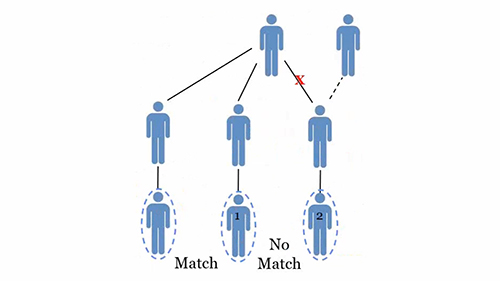
To fully grasp these advanced methodologies and see them applied to real-world case studies, viewing the complete webinar is highly recommended. Witnessing the visual breakdown of the Y-DNA Block Tree and the specific mutation rates of various markers will provide the clarity needed to apply these techniques to your own research. Genealogists are also encouraged to explore the comprehensive seven-page syllabus, which contains essential matching thresholds, comparison tables, and further reading to guide your journey into the deep science of genetic genealogy.









 Facebook
 X
X
 Syllabus


Thank you Blaine. This is so clear and I believe will be a big help for first time Y-DNA testors to promote the usage and continued function of the testing platform.
Wonderful presentation! I find that STRs sometimes show a unique pattern and these patterns define related groups.
Blaine Bettinger is my favorite presenter. He’s as clear, uncluttered and directed as I can imagine.
I love the clarity and focus Blaine brings to every topic he teaches. Y-DNA has been a difficult tool for me to fully understand while working to identify my husband’s surprise paternal grandfather and his lineage. Blaine’s ability to teach in a clear, organized, and on-track way has given us real hope that we may still discover the surname and hereditary line.
Very much enjoying these DNA series.
Great stuff!
If only Blaine did every webinar on every topic what a perfect world of understanding genealogy and DNA would be. While I have not, and may not, submit a sample for Y-DNA testing, this webinar gave me a slight push toward doing so once I go back and view his previous webinar(s) on the topic. His presentations make learning enjoyable because he is a “teacher” and wants those viewing his work to come away with an understanding of the subject at a level where it all makes sense. Well worth the time spent.
Blaine is always an excellent presenter. I was very glad to have a course being slightly more in-depth on understanding what is being presented with Y testing, and what can be derived from the results provided. You will find that further great strides have been made in some of the Y-haplo discussion groups on FTDNA that were not mentioned here (content for the next level up?), where the groups are then driving data and process items back to FTDNA and Y-Full.