



Many English DNA matches have rudimentary online trees. Learn about online resources for quickly and inexpensively extending the trees to find possible connections. Many North Americans have limited or no understanding of twentieth century online records that can be used to extend rudimentary or no online trees for their English DNA matches. There is a big need to be able to get the trees far enough back in time to possibly find the nearest common ancestors. This presentation will look at the different record groups explaining, with examples, how to use the different records together, and the time periods for which they are appropriate. Records discussed with illustrations and limitations include: – Civil Registration – Probate – Cemeteries / Crematoriums – Newspapers – Funeral notices – Voter registrations – Telephone directories – More
This webinar, English DNA Matches: Tools for Quickly Building Modern Trees with Paul Milner, demonstrates a practical, methodical approach to turning bare or private DNA matches into fully fleshed-out 20th-century family trees for England and Wales. Using a real case study involving matches in Kent, Paul shows how to move from a simple surname clue and an estimated relationship on MyHeritage to a documented shared ancestral couple, all while navigating modern records, changing indexes, and the economics of ordering certificates.
Work from both ends of the problem. The session stresses starting simultaneously from the known tree and the DNA match’s limited information, using the estimated relationship and shared matches (e.g., paternal-side indicators) to form an initial hypothesis. That hypothesis is then tested by building a quick “working tree” forward and backward in time until the two lines either converge on a plausible common ancestor or can be ruled out.
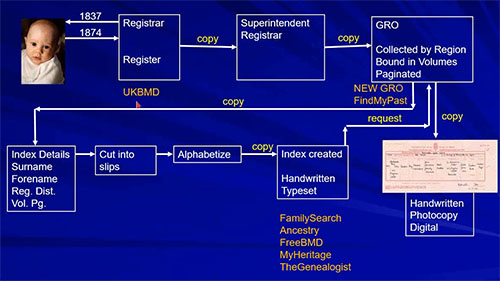
Exploit modern British sources creatively and across platforms. A central theme is the power of combining civil registration indexes, the 1939 Register, 1911 and 1921 censuses, electoral registers, online probate calendars, funeral notices, and multiple commercial sites (Findmypast, Ancestry, MyHeritage, FreeBMD). The webinar highlights subtle but crucial differences between indexes (such as when mothers’ maiden names appear, or how death index formats change after 1969), shows how to spot second marriages and name changes, and demonstrates why checking condolence messages and address histories can reveal married names and hidden relationships.
Balance speed with rigor and guard against confirmation bias. Paul models how to build “fast but careful” trees: choosing likely candidates based on geography and uncommon surnames, then verifying each step with independent sources. He emphasizes not accepting the first seemingly correct match, comparing DNA relationship estimates with reconstructed pedigrees, and being aware of rising costs for documents like probate copies when deciding which records will provide the best proof for the price.
Genealogists interested in English and Welsh research will gain a clear roadmap for turning anonymous DNA matches into well-grounded lineage connections, especially in the often-tricky 20th century. To see each search in action, understand precisely how the various indexes interact, and watch the complete case study unfold from raw DNA match to proven shared ancestors, viewers are encouraged to watch the full webinar. The detailed syllabus includes links to additional sessions on English civil registration, probate, census analysis, immigration, and 20th-century research techniques, and genealogists are invited to explore these resources to extend and refine the methods introduced in this presentation.









 Facebook
 X
X
 Syllabus


Great presentation!
Wonderful, as always! Thanks for sharing your extensive knowledge! Always happy to learn of new resources.
This was a wonderful webinar with very clear explanations. This opens up a complete new space for my research in England, trying to find out what happened to the emigrants who left the Kingdom of Wuerttemberg or my UK DNA matches were I struggled so far to find the connections.
very well explained on the different platforms
Very interesting and pitched a a good level for beginners right through to more experienced genealogists. I really enjoyed it.
Paul’s presentations are always easy to follow, easy to understand, and have enough examples that everyone will learn something new each time. I have attended his lectures for probably twenty years and always come away motivated to return to doing more research on my British ancestry.
Paul did an amazing job! Absolutely loved this webinar. It was very easy to follow because he took this case study one step at a time. I feel like I know this family. He took the DNA Matches through their genealogy, even though they didn’t have linked public trees. Wonderful!
Brilliant. I enjoyed the personal, thoughtful, methodology. Using ALL the different index opportunities, (although costly) adds integrity to an acceptable conclusion, a relationship. The GPS is satisfied here with the exhaustiveness.