Foundations in AI for Family History 4 of 5: Smart Tools—AI Helpers for Genealogy Tasks
Andrew Redfern, Fiona Brooker

Content


About this webinar
Learn the principles, tools, and responsible practices for using AI in your genealogical research.
About the speakers


Key points and insights
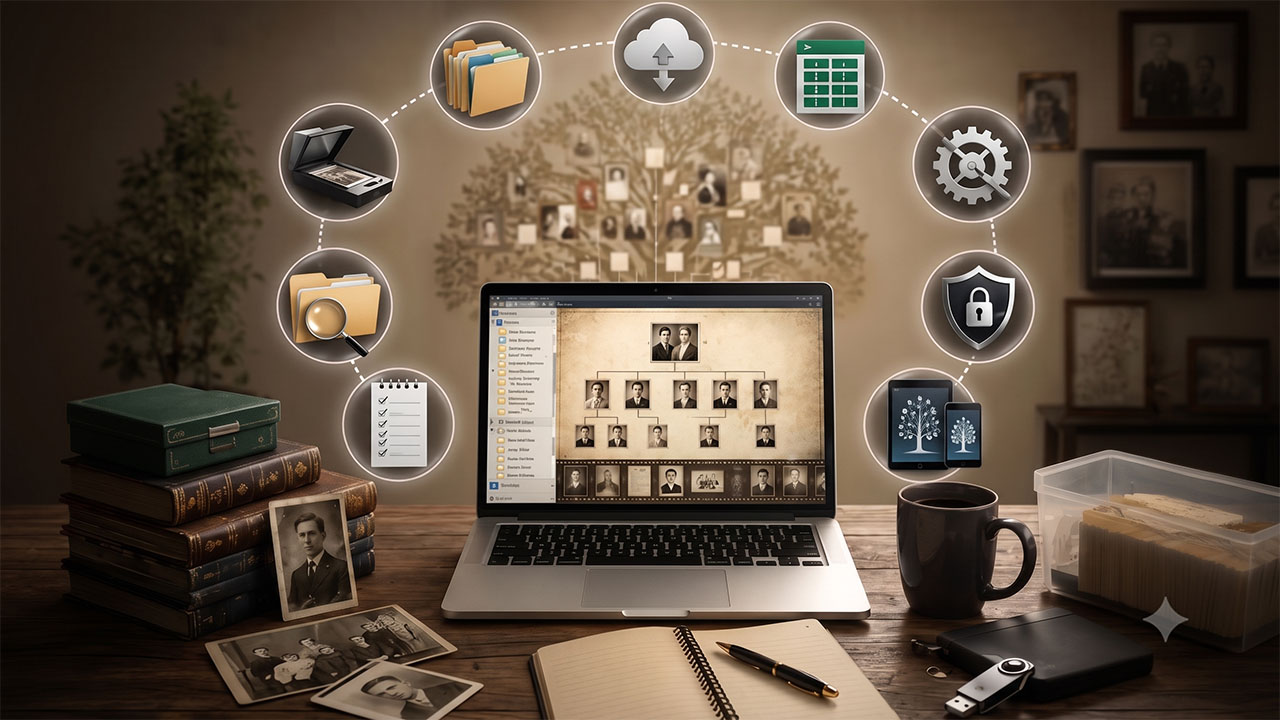
In this session of the Legacy Family Tree Webinars, presenters Fiona Brooker and Andrew Redfern explore the intersection of artificial intelligence and ancestral research, specifically focusing on "smart tools" that serve as digital assistants for common genealogy tasks. As AI continues to evolve, it offers genealogists unprecedented ways to analyze historical documents, organize fragmented data, and even restore cherished family media. This webinar moves beyond the theoretical, providing practical demonstrations of how various AI platforms can be integrated into a researcher’s workflow to overcome traditional roadblocks such as difficult handwriting, unindexed records, and fading photographs.
The Power of Full-Text Search: One of the most significant advancements in the field is Family Search’s AI-powered full-text search, which allows researchers to look beyond basic indexes to find ancestor names within the actual body of deeds, wills, and court records, uncovering details that were previously "hidden" in plain sight.
A "Task-First" Approach to Tool Selection: Rather than relying on a single platform, effective genealogists should choose their AI based on the specific task at hand—using Transkribus for dedicated handwriting recognition, ChatGPT or Claude for narrative structuring, and MyHeritage’s specialized tools for animating or enhancing historical images.
The Ethical Continuum: AI usage in genealogy exists on a spectrum from preservation to impersonation; consequently, researchers must apply constant human judgment and ethical care, especially when using tools that "fill in the gaps" of images or clone the voices of deceased relatives.
To fully grasp the transformative potential of these AI assistants, viewing the complete webinar is highly recommended. The live demonstrations illustrate how to navigate different interfaces and, more importantly, how to refine prompts to achieve the most accurate genealogical summaries and research logs. For those ready to implement these strategies, the accompanying syllabus contains a wealth of additional resources, specialized prompts, and comparison charts designed to help any researcher build a more efficient and technologically savvy family history practice.
Related webinars
 01:18:18
 01:18:31




Comments (66)
I am interested in AI but have only used some of it's simpler functions. I will need to review this series a couple more times.
This series is great, well worth the price of admission.
It was an excellent and practical session, full of new ideas that could be applied immediately to everyday research tasks. The presenters showed how AI tools can assist with activities such as summarising documents, extracting key details, transcribing documents, and looking forward to fifth one.
This was another excellent AI webinar!
This series about AI really blows my mind! Amazing possibilities for transcriptions, chart development, photo fixing and animations! Wow! Going to start playing with it now! Thanks!
Foundations in AI for Family History - AMAZING! This-more-intensive-than-just-a-single-webinar course is next level in helping me learn the tools and techniques to employ AI in my family history research. Thank you so much Andrew Redfern and Fiona Brooker!
Wow another amazing webinar! So much great information to practise on. AI is just so fascinating and can do so much. I have to do some serious practising before the next session. Thank you both.
I would give this a 10 if I could. Outstanding information, well explained and I wish they had another 2 hours to go demonstrate the different AI tools and platforms. Great job and well done.