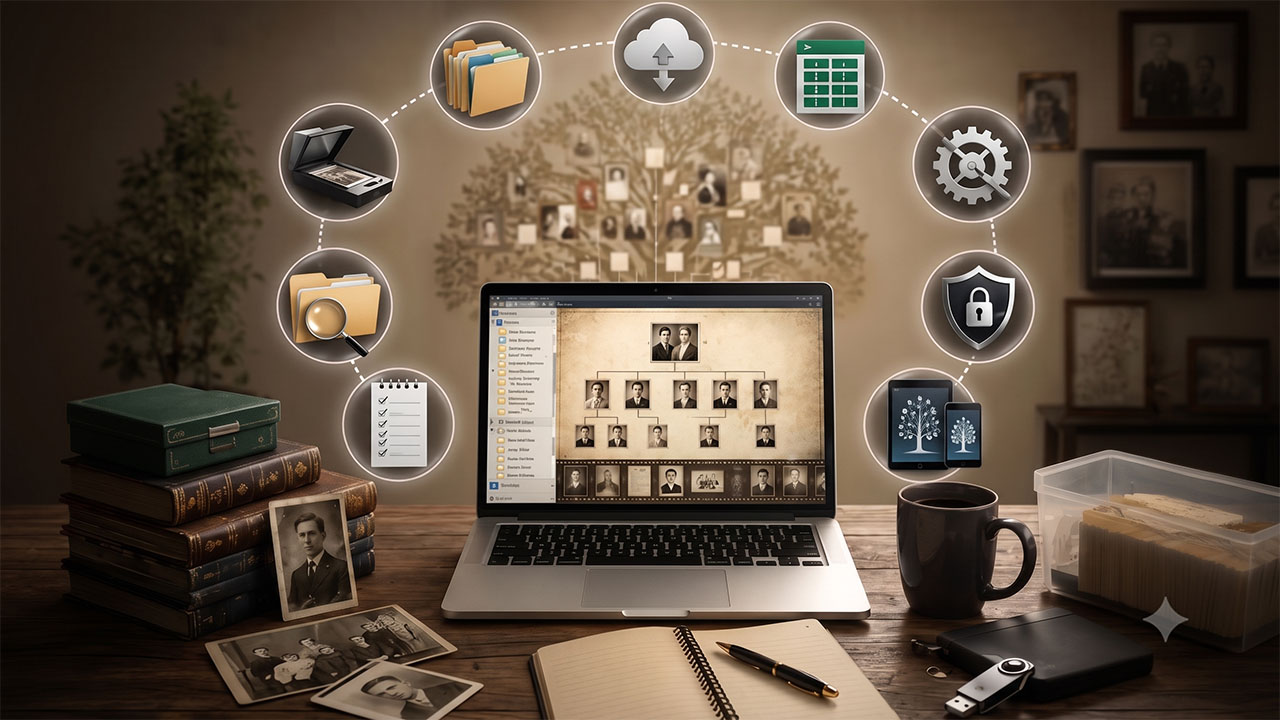
Is your digital family history hiding in plain sight? Stop letting your hard work disappear into generic filenames like “IMG_0054.jpg.” This video reveals the power of metadata—the digital equivalent of writing names and dates on the back of a physical photo. You will learn how to permanently embed stories, citations, and faces directly inside your files, ensuring that your research travels safely wherever your photos go. Watch now to transform your chaotic folders into a searchable, future-proof archive and guarantee that your ancestors’ identities are never lost again.
* * *
Author’s Note: I want to be transparent that this material – DESC Tech Tip – Using Metadata for Genealogy – was created in part with the help of an artificial intelligence (AI) language model – Gemini Pro 3. The AI assisted in generating an early draft of the article, but every paragraph was subsequently reviewed, edited, and refined by me. The final content is the result of extensive human curation and creativity. I am proud to present this work and assure readers that while AI was a tool in the process, the story, style, and substance have been carefully shaped by the author.
Is your digital family history hiding in plain sight? Stop letting your hard work disappear into generic filenames like “IMG_0054.jpg.” This video reveals the power of metadata—the digital equivalent of writing names and dates on the back of a physical photo. You will learn how to permanently embed stories, citations, and faces directly inside your files, ensuring that your research travels safely wherever your photos go. Watch now to transform your chaotic folders into a searchable, future-proof archive and guarantee that your ancestors’ identities are never lost again.
* * *
Author’s Note: I want to be transparent that this material – DESC Tech Tip – Using Metadata for Genealogy – was created in part with the help of an artificial intelligence (AI) language model – Gemini Pro 3. The AI assisted in generating an early draft of the article, but every paragraph was subsequently reviewed, edited, and refined by me. The final content is the result of extensive human curation and creativity. I am proud to present this work and assure readers that while AI was a tool in the process, the story, style, and substance have been carefully shaped by the author.
Ever click a source in your family tree only to find a “Page Not Found” error? Stop losing your evidence! This video reveals how to use the Internet Archive’s Wayback Machine to save webpages forever. You’ll learn how to create permanent, unbreakable links for your citations, ensuring your research on obituaries and local history sites remains verifiable—even if the original site goes offline. Protect your hard work from digital decay. Watch now to make your genealogy research professional, permanent, and future-proof.
* * *
Author’s Note: I want to be transparent that this material – DESC Tech Tip – Internet Archive Saving a Webpage – was created in part with the help of an artificial intelligence (AI) language model – Gemini Pro 3. The AI assisted in generating an early draft of the article, but every paragraph was subsequently reviewed, edited, and refined by me. The final content is the result of extensive human curation and creativity. I am proud to present this work and assure readers that while AI was a tool in the process, the story, style, and substance have been carefully shaped by the author.
Ever click a source in your family tree only to find a “Page Not Found” error? Stop losing your evidence! This video reveals how to use the Internet Archive’s Wayback Machine to save webpages forever. You’ll learn how to create permanent, unbreakable links for your citations, ensuring your research on obituaries and local history sites remains verifiable—even if the original site goes offline. Protect your hard work from digital decay. Watch now to make your genealogy research professional, permanent, and future-proof.
* * *
Author’s Note: I want to be transparent that this material – DESC Tech Tip – Internet Archive Saving a Webpage – was created in part with the help of an artificial intelligence (AI) language model – Gemini Pro 3. The AI assisted in generating an early draft of the article, but every paragraph was subsequently reviewed, edited, and refined by me. The final content is the result of extensive human curation and creativity. I am proud to present this work and assure readers that while AI was a tool in the process, the story, style, and substance have been carefully shaped by the author.
Stop getting generic, surface-level answers from AI! The secret to breaking brick walls isn’t just asking questions—it’s assigning Roles. In this video, discover how telling AI to “act as” a professional archivist, DNA expert, or social historian transforms it from a basic chatbot into a specialized research partner.
We reveal the top 5 personas that unlock deeper historical context, decipher impossible handwriting, and analyze evidence with professional rigor. Don’t just chat with AI; build your own expert research team. Watch now to revolutionize your family history strategy.
* * *
Author’s Note: I want to be transparent that this material – DESC Tech Tip – Using Roles for AI Prompts – was created in part with the help of an artificial intelligence (AI) language model – Gemini Pro 3. The AI assisted in generating an early draft of the article, but every paragraph was subsequently reviewed, edited, and refined by me. The final content is the result of extensive human curation and creativity. I am proud to present this work and assure readers that while AI was a tool in the process, the story, style, and substance have been carefully shaped by the author.
Stop getting generic, surface-level answers from AI! The secret to breaking brick walls isn’t just asking questions—it’s assigning Roles. In this video, discover how telling AI to “act as” a professional archivist, DNA expert, or social historian transforms it from a basic chatbot into a specialized research partner.
We reveal the top 5 personas that unlock deeper historical context, decipher impossible handwriting, and analyze evidence with professional rigor. Don’t just chat with AI; build your own expert research team. Watch now to revolutionize your family history strategy.
* * *
Author’s Note: I want to be transparent that this material – DESC Tech Tip – Using Roles for AI Prompts – was created in part with the help of an artificial intelligence (AI) language model – Gemini Pro 3. The AI assisted in generating an early draft of the article, but every paragraph was subsequently reviewed, edited, and refined by me. The final content is the result of extensive human curation and creativity. I am proud to present this work and assure readers that while AI was a tool in the process, the story, style, and substance have been carefully shaped by the author.
From Problem to Solution: A Case Study Approach to Using AI in Genealogy
Artificial intelligence is changing the way genealogists work—but how do you move beyond tips and tricks to apply AI in a sound, methodical way? In this session, Andrew Redfern demonstrates how a case study approach provides the answer. Using real examples, he walks through the stages of tackling a genealogical problem with AI, showing how tools can assist with transcription, analysis, correlation of evidence, and presentation of findings. Rather than treating AI as a shortcut, Andrew highlights how to integrate it into the established genealogical research cycle—problem definition, source gathering, analysis, and conclusion. Attendees will see how AI can clarify complex evidence, save time on repetitive tasks, and support storytelling, while still requiring human expertise and critical thinking. By the end of the session, participants will have a practical framework they can adapt to their own research problems, ensuring that AI becomes a trusted partner in genealogical methodology.
Tracing an Ancestor’s Journey with ChatGPT: Unraveling Family History with AI
Explore how AI technology, exemplified by ChatGPT, can revolutionize your family history, by embarking on a journey through an ancestor’s life, leveraging AI to uncover his story and shed light on the broader implications for genealogical research!
AI as Partner, Not Replacement: Human-Led Research Planning in the Sally Keaton Case
This lecture explores how modern AI tools can assist genealogical research planning through the case of Sally Keaton, where the objective was to identify her children using limited historical records and DNA evidence. The presentation demonstrates how to structure effective research plans with AI assistance, covering essential elements including clear objectives, summaries of known facts, working hypotheses, identified sources, and prioritized strategies. Using Sally Keaton’s case as the central example, the lecture showcases practical AI tools, such as side-by-side editors: Canvas (ChatGPT and Gemini) and Artifacts (Claude); also advanced capabilities including reasoning models and organizational tools like ChatGPT’s Projects, Claude’s Projects, Perplexity’s Spaces, and Gemini Gems. While AI can create research plans on its own, human-AI collaboration produces better results. When researchers guide and refine AI-generated strategies instead of using fully automated planning, they achieve more accurate results.
Genealogy Meets the Internet Archive and AI: A Comprehensive Review
Learn to harness the Internet Archive’s free digital library—a treasure trove of digitized family histories, city directories, census and church records—to enrich your genealogy research. Learn how to build complex prompts to build an index of surnames on a 400 page genealogy book from 1898. Learn how to extract a list of migration routes from the same book, organized by surname, then in generation order, and placed in an Excel file. With the help of AI, you can get the most out of Internet Archive.
Genealogy in Your Pocket: 5 Simple iPhone Tricks for Family History
Family history can happen when you least expect it: having coffee with your cousin, passing a commemorative plaque, or on the road. Here are 5 simple iPhone tricks to make sure you never miss an opportunity to break a brick wall.
Learn how to use artificial intelligence to help find important family information, understand old documents, and craft compelling family stories to support your family history research. This webinar will introduce you to the best uses of AI in genealogy today and give a peek behind the curtain of what genealogists can look forward to from AI advancements in 2026.
Gedcom files are useful for transferring family tree data but they aren’t easy to read or work with on their own. In this TechZone, we’ll explain how you can use AI to easily extract information from a gedcom file and create word documents or spreadsheet.
Turn genealogical facts into captivating videos. This session will empower family historians who have only modest tech skills to create short, shareable videos that resonate with all ages. Using Animoto, Canva, iMovie, or Camtasia, learn to blend photos, music, and narration. The result will be magic! Discover how to digitize artifacts, and source public-domain images from places like the New York Public Library’s scanned books. Use AI transcription tools for. Attendees will leave excited to produce a 2–3-minute video story. No video editing skills are needed. This session will draw upon real examples created with the simplest of tools.
Advanced Census Research: Understanding Census Enumerators and Their Instructions
Wed, February 4 2026: 16:30 UTC
The census is one of our basic research tools, but basic doesn’t equal simple. Often a census record can raise as many questions as it answers, and some of those questions may seem unanswerable. Learn how an understanding of who the enumerators were, what their instructions prescribed, and some of the many ways they deviated from the instructions can answer many of the questions raised by census research.
The Many Faces of the Census: Beyond the Population Schedule – Agricultural, Mortality, and Industry Records
Wed, February 4 2026: 17:45 UTC
Most researchers stop at the population schedule, but census records also include valuable schedules that document farms, businesses, deaths, and community life. This session explores agricultural, mortality, and industry schedules, showing how they can be used to add depth to family history.
Case Studies in Census Conflicts – Resolving Contradictions Across Decades
Wed, February 4 2026: 19:00 UTC
Census records often contradict one another. Ages change, names vary, and places of birth are inconsistent. This session demonstrates how to analyze and reconcile those conflicts through timelines, correlation with other records, and case studies that show how to draw conclusions from imperfect evidence.
By registering, you are submitting your information to Legacy Family Tree Webinars and agreeing to let us use it to contact you.
Thank you for registering!
You should receive a confirmation email with a link to the webinar soon.
You’ll also receive a reminder both the day before and one hour before the webinar begins. Didn’t receive a confirmation email?
You successfully registered for %s.
You should receive a confirmation email with a link to the webinar soon.
You’ll also receive a reminder both the day before and one hour before the webinar begins. Didn’t receive a confirmation email?