36
of
2,612 Webinars
for
“google “ Clear search Clear search
Sort by
Sort by
1:49:51
Using Google Earth Web to Tell Your Family History Migration Stories
Learn how to use the free Google Earth Web platform to create and share engaging, interactive, multimedia stories that follow the footsteps of your ancestors. Although both the web and desktop versions have Google Earth in their name, they are very different. Learn how to navigate the platform interface, add multimedia content to your digital story, share your digital family history story, and preserve it. We will also discuss best practices for planning your Google Earth Web story. No coding skills needed!
Fri, October 31 2025: 18:00 UTC
54:28
1.2K views
French
CC
7 conseils de productivité pour Google Chrome
Les sous-titres et la voix de cette vidéo ont été doublés en français à l’aide de l’IA. Le logiciel de généalogie numéro 1 est probablement… Google Chrome ! Statistiquement, Chrome est le navigateur numéro 1, et tant de recherches généalogiques se font dans un navigateur. Découvrez 7 façons de rendre vos recherches généalogiques plus productives en utilisant Google Chrome.
Wed, May 7 2025: 2:00 UTC
54:28
1.2K views
CC
7 Productivity Tips for Google Chrome
The #1 genealogy software is probably…Google Chrome! Statistically, Chrome is the #1 browser, and so much genealogy research happens in a browser. Learn 7 ways to make your genealogy research more productive while using Google Chrome.
Wed, May 7 2025: 2:00 UTC
48:15
940 views
French
CC
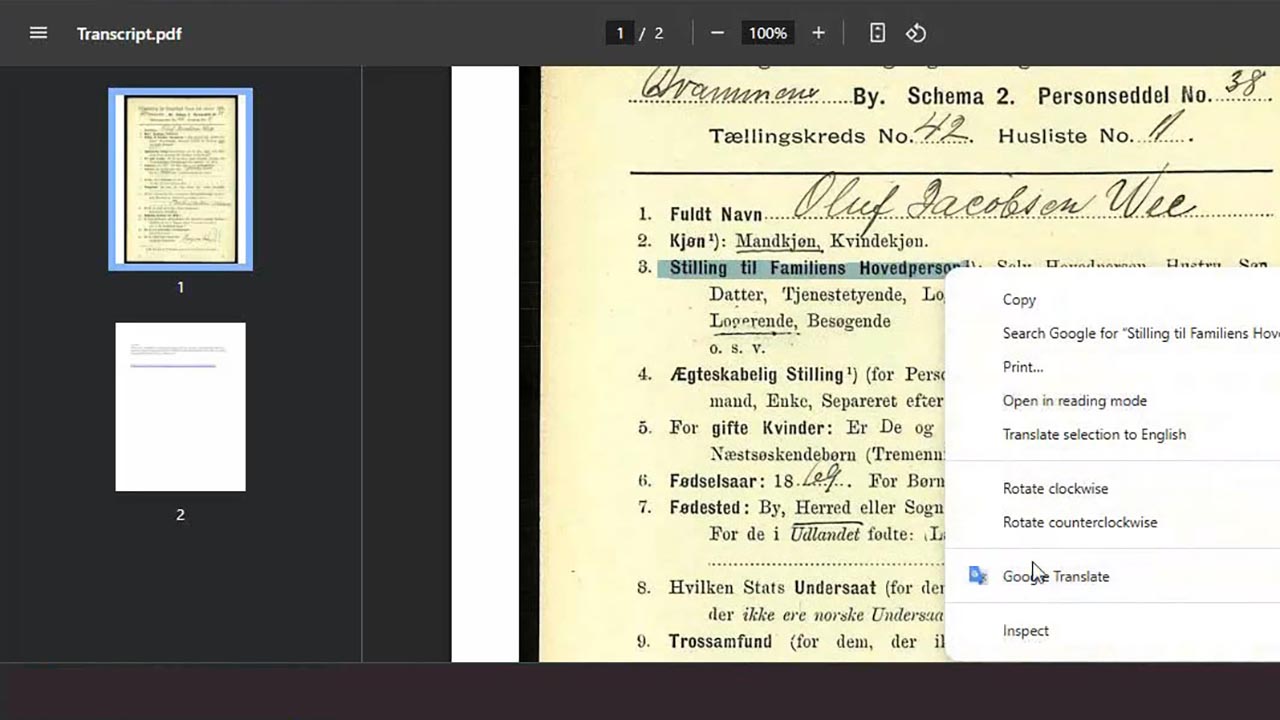
Améliorer vos recherches généalogiques : comment utiliser l’extension Chrome Google Translate
Les sous-titres et la voix de cette vidéo ont été doublés en français à l’aide de l’IA. Saviez-vous que l’outil Google Translate sur lequel vous comptez en tant que généalogiste est également disponible en tant qu’extension de navigateur pratique ? Avec cette extension, vous pouvez traduire instantanément du texte directement sur la page que vous consultez, sans avoir à changer d’onglet ou à ouvrir une nouvelle fenêtre. C’est un moyen fluide de surmonter les barrières linguistiques tout en restant concentré sur vos recherches !
Fri, April 4 2025: 17:00 UTC
48:15
935 views
CC
Boosting Your Genealogy Research: How to Leverage the Google Translate Chrome Extension
Did you know that the Google Translate tool you rely on as a genealogist also comes in a convenient browser extension? With this extension, you can instantly translate text right on the page you’re viewing, without the hassle of switching tabs or opening a new window. It’s a seamless way to break down language barriers while staying focused on your research!
Fri, April 4 2025: 17:00 UTC
5:33
946 views
Google Alerts: Make Google Work for You!
It isn’t always easy to determine new content that has been added to Google, especially if you are on the hunt for information posted by others about your ancestors. Learn how to harness the power of Google Alerts and get notified via e-mail or RSS feed when anything new pops up on Google that can help your genealogy research. This was part of the webinar, Celebrating 2,000 webinars! Plus 10 tips you can use today.
Fri, July 14 2023: 0:00 UTC
59:07
Using Google Books to Find the Law
Time and time again, we’re told to look at records in the context of the law at the time and in the place where the records were created. Easier said than done! With 50 states and the federal government all passing laws, how do we find the laws we need? One answer is Google Books—if we use it to full advantage.
Fri, September 16 2022: 15:30 UTC
7:43
1.0K views
CC
Customize Your Google Chrome Homepage
In this TechZone video learn how to customize your Google Chrome homepage to add a background image, add recipe cards or add shortcuts.
Fri, January 7 2022: 6:00 UTC
6:36
561 views
CC
Using Google Chrome’s Reading List
Google Chrome has a reading list feature that is different from its bookmarks bar. Learn the benefits of the reading list and how to use it from Gena Philibert-Ortega.
Fri, December 3 2021: 0:00 UTC
3:14
785 views
CC
Convert a JPEG image to a Word Document using Google Drive
Have you ever received an image or a scan with text on it and wished that you could capture or edit the text without retyping it? Amie Bowser Tennant shows you how to do this with the help of Google Drive.
Fri, October 22 2021: 0:00 UTC
7:11
1.9K views
CC
Get it Together! 5 Tips to Make Google Calendar Work for You
These 5 Google Calendar tips will have your calendar organized in no time!
Fri, May 7 2021: 0:00 UTC
5:39
2.5K views
CC
How to use Google Photos to Possibly Identify Ancestors in Old Photos
Lisa Louise Cooke shows us how to use the group similar faces feature in Google Photos to help identify our ancestors in photos.
Fri, August 14 2020: 0:00 UTC

Upcoming Live Webinars

View all (179)
Wed, January 7 2026: 16:30 UTC
Genealogy Meets the Internet Archive and AI: A Comprehensive Review
Wed, January 7 2026: 16:30 UTC
Learn to harness the Internet Archive’s free digital library—a treasure trove of digitized family histories, city directories, census and church records—to enrich your genealogy research. Learn how to build complex prompts to build an index of surnames on a 400 page genealogy book from 1898. Learn how to extract a list of migration routes from the same book, organized by surname, then in generation order, and placed in an Excel file. With the help of AI, you can get the most out of Internet Archive.
Wed, January 7 2026: 16:30 UTC
Wed, January 7 2026: 17:45 UTC
AI as Partner, Not Replacement: Human-Led Research Planning in the Sally Keaton Case
Wed, January 7 2026: 17:45 UTC
This lecture explores how modern AI tools can assist genealogical research planning through the case of Sally Keaton, where the objective was to identify her children using limited historical records and DNA evidence. The presentation demonstrates how to structure effective research plans with AI assistance, covering essential elements including clear objectives, summaries of known facts, working hypotheses, identified sources, and prioritized strategies. Using Sally Keaton’s case as the central example, the lecture showcases practical AI tools, such as side-by-side editors: Canvas (ChatGPT and Gemini) and Artifacts (Claude); also advanced capabilities including reasoning models and organizational tools like ChatGPT’s Projects, Claude’s Projects, Perplexity’s Spaces, and Gemini Gems. While AI can create research plans on its own, human-AI collaboration produces better results. When researchers guide and refine AI-generated strategies instead of using fully automated planning, they achieve more accurate results.
Wed, January 7 2026: 17:45 UTC
Wed, January 7 2026: 19:00 UTC
Unraveling Family History with AI: Leveraging AI to Trace an Ancestor’s Journey, with Chat GPT (Free Version)
Wed, January 7 2026: 19:00 UTC
Explore how AI technology, exemplified by ChatGPT, can revolutionize your family history, by embarking on a journey through an ancestor’s life.
Wed, January 7 2026: 19:00 UTC
Wed, January 7 2026: 20:30 UTC
From Problem to Solution: A Case Study Approach to Using AI in Genealogy
Wed, January 7 2026: 20:30 UTC
Artificial intelligence is changing the way genealogists work—but how do you move beyond tips and tricks to apply AI in a sound, methodical way? In this session, Andrew Redfern demonstrates how a case study approach provides the answer. Using real examples, he walks through the stages of tackling a genealogical problem with AI, showing how tools can assist with transcription, analysis, correlation of evidence, and presentation of findings. Rather than treating AI as a shortcut, Andrew highlights how to integrate it into the established genealogical research cycle—problem definition, source gathering, analysis, and conclusion. Attendees will see how AI can clarify complex evidence, save time on repetitive tasks, and support storytelling, while still requiring human expertise and critical thinking. By the end of the session, participants will have a practical framework they can adapt to their own research problems, ensuring that AI becomes a trusted partner in genealogical methodology.
Wed, January 7 2026: 20:30 UTC
Tue, January 13 2026: 14:00 UTC
Spanish
La fotografía de un desconocido: ¿punto de partida para una genealogía?
Tue, January 13 2026: 14:00 UTC
En la actualidad, cuando casi cualquier cosa pasa por la IA, el descubrimiento de una fotografía hecha a finales del siglo XIX o principios del siglo XX, no solo nos traslada a otro momento de la historia en el que el contexto era totalmente diferente, sino que nos abre las posibilidades de estudio de una persona y de una familia. Pero, además, ¿qué nos aporta una fotografía de un desconocido? ¿cuánto podemos averiguar de él y de su entorno? Una fotografía es un documento de memoria colectiva y, como tal, aporta una fuente de información sobre estructura familiar, estilo de vida y valores sociales de la época.
José Antonio González Marrero
En la actualidad, cuando casi cualquier cosa pasa por la IA, el descubrimiento de una fotografía hecha a finales del siglo XIX o principios del siglo XX, no solo nos traslada a otro momento de la historia en el que el contexto era totalmente diferente, sino que nos abre las posibilidades de estudio de una persona y de una familia. Pero, además, ¿qué nos aporta una fotografía de un desconocido? ¿cuánto podemos averiguar de él y de su entorno? Una fotografía es un documento de memoria colectiva y, como tal, aporta una fuente de información sobre estructura familiar, estilo de vida y valores sociales de la época.
Tue, January 13 2026: 14:00 UTC
Tue, January 13 2026: 19:00 UTC
Using MyHeritage in Your Genealogical DNA Testing Plan
Tue, January 13 2026: 19:00 UTC
We often need other family members to take a DNA test for us to help us solve our genealogical problems. We’ll discuss ways MyHeritage can help us find, test, and collaborate with our DNA cousins.
Tue, January 13 2026: 19:00 UTC