Si les pierres tombales pouvaient parler, elles auraient beaucoup d’histoires à raconter. Mais elles ne le peuvent pas, c’est pourquoi BillionGraves est la meilleure alternative. BillionGraves est la plus grande base de données au monde sur les cimetières, reliée à un système GPS. Lorsque vous prenez des photos avec l’application BillionGraves sur votre téléphone, chaque pierre tombale est automatiquement marquée d’une position GPS. Les données sont ensuite transcrites par des bénévoles, reportées sur des plans de cimetières et conservées sur les sites web BillionGraves, FamilySearch et MyHeritage pour des millions de familles à travers le monde et pour les générations futures.
Les sous-titres et la voix de cette vidéo ont été doublés en français à l’aide de l’IA.
Si les pierres tombales pouvaient parler, elles auraient beaucoup d’histoires à raconter. Mais elles ne le peuvent pas, c’est pourquoi BillionGraves est la meilleure alternative. BillionGraves est la plus grande base de données au monde sur les cimetières, reliée à un système GPS. Lorsque vous prenez des photos avec l’application BillionGraves sur votre téléphone, chaque pierre tombale est automatiquement marquée d’une position GPS. Les données sont ensuite transcrites par des bénévoles, reportées sur des plans de cimetières et conservées sur les sites web BillionGraves, FamilySearch et MyHeritage pour des millions de familles à travers le monde et pour les générations futures.
Les sous-titres et la voix de cette vidéo ont été doublés en français à l’aide de l’IA.
Si las lápidas pudieran hablar, tendrían muchas historias que contar. Pero no pueden, por eso BillionGraves es la mejor alternativa. BillionGraves es la mayor base de datos del mundo sobre cementerios, conectada a un sistema GPS. Cuando se toman fotos con la aplicación BillionGraves en el teléfono, cada lápida se marca automáticamente con una posición GPS. A continuación, los datos son transcritos por voluntarios, transferidos a planos de cementerios y almacenados en los sitios web BillionGraves, FamilySearch y MyHeritage para millones de familias de todo el mundo y para las generaciones futuras.
Los subtítulos y la voz de este vídeo se han doblado al español utilizando IA.
Si las lápidas pudieran hablar, tendrían muchas historias que contar. Pero no pueden, por eso BillionGraves es la mejor alternativa. BillionGraves es la mayor base de datos del mundo sobre cementerios, conectada a un sistema GPS. Cuando se toman fotos con la aplicación BillionGraves en el teléfono, cada lápida se marca automáticamente con una posición GPS. A continuación, los datos son transcritos por voluntarios, transferidos a planos de cementerios y almacenados en los sitios web BillionGraves, FamilySearch y MyHeritage para millones de familias de todo el mundo y para las generaciones futuras.
Los subtítulos y la voz de este vídeo se han doblado al español utilizando IA.
Turn genealogical facts into captivating videos. This session will empower family historians who have only modest tech skills to create short, shareable videos that resonate with all ages. Using Animoto, Canva, iMovie, or Camtasia, learn to blend photos, music, and narration. The result will be magic! Discover how to digitize artifacts, and source public-domain images from places like the New York Public Library’s scanned books. Use AI transcription tools for. Attendees will leave excited to produce a 2–3-minute video story. No video editing skills are needed. This session will draw upon real examples created with the simplest of tools.
Turn genealogical facts into captivating videos. This session will empower family historians who have only modest tech skills to create short, shareable videos that resonate with all ages. Using Animoto, Canva, iMovie, or Camtasia, learn to blend photos, music, and narration. The result will be magic! Discover how to digitize artifacts, and source public-domain images from places like the New York Public Library’s scanned books. Use AI transcription tools for. Attendees will leave excited to produce a 2–3-minute video story. No video editing skills are needed. This session will draw upon real examples created with the simplest of tools.
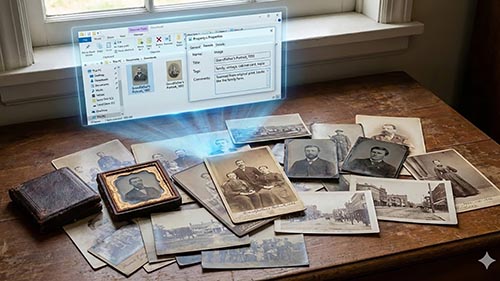
Is your digital family history hiding in plain sight? Stop letting your hard work disappear into generic filenames like “IMG_0054.jpg.” This video reveals the power of metadata—the digital equivalent of writing names and dates on the back of a physical photo. You will learn how to permanently embed stories, citations, and faces directly inside your files, ensuring that your research travels safely wherever your photos go. Watch now to transform your chaotic folders into a searchable, future-proof archive and guarantee that your ancestors’ identities are never lost again.
* * *
Author’s Note: I want to be transparent that this material – DESC Tech Tip – Using Metadata for Genealogy – was created in part with the help of an artificial intelligence (AI) language model – Gemini Pro 3. The AI assisted in generating an early draft of the article, but every paragraph was subsequently reviewed, edited, and refined by me. The final content is the result of extensive human curation and creativity. I am proud to present this work and assure readers that while AI was a tool in the process, the story, style, and substance have been carefully shaped by the author.
Is your digital family history hiding in plain sight? Stop letting your hard work disappear into generic filenames like “IMG_0054.jpg.” This video reveals the power of metadata—the digital equivalent of writing names and dates on the back of a physical photo. You will learn how to permanently embed stories, citations, and faces directly inside your files, ensuring that your research travels safely wherever your photos go. Watch now to transform your chaotic folders into a searchable, future-proof archive and guarantee that your ancestors’ identities are never lost again.
* * *
Author’s Note: I want to be transparent that this material – DESC Tech Tip – Using Metadata for Genealogy – was created in part with the help of an artificial intelligence (AI) language model – Gemini Pro 3. The AI assisted in generating an early draft of the article, but every paragraph was subsequently reviewed, edited, and refined by me. The final content is the result of extensive human curation and creativity. I am proud to present this work and assure readers that while AI was a tool in the process, the story, style, and substance have been carefully shaped by the author.
Ever click a source in your family tree only to find a “Page Not Found” error? Stop losing your evidence! This video reveals how to use the Internet Archive’s Wayback Machine to save webpages forever. You’ll learn how to create permanent, unbreakable links for your citations, ensuring your research on obituaries and local history sites remains verifiable—even if the original site goes offline. Protect your hard work from digital decay. Watch now to make your genealogy research professional, permanent, and future-proof.
* * *
Author’s Note: I want to be transparent that this material – DESC Tech Tip – Internet Archive Saving a Webpage – was created in part with the help of an artificial intelligence (AI) language model – Gemini Pro 3. The AI assisted in generating an early draft of the article, but every paragraph was subsequently reviewed, edited, and refined by me. The final content is the result of extensive human curation and creativity. I am proud to present this work and assure readers that while AI was a tool in the process, the story, style, and substance have been carefully shaped by the author.
Ever click a source in your family tree only to find a “Page Not Found” error? Stop losing your evidence! This video reveals how to use the Internet Archive’s Wayback Machine to save webpages forever. You’ll learn how to create permanent, unbreakable links for your citations, ensuring your research on obituaries and local history sites remains verifiable—even if the original site goes offline. Protect your hard work from digital decay. Watch now to make your genealogy research professional, permanent, and future-proof.
* * *
Author’s Note: I want to be transparent that this material – DESC Tech Tip – Internet Archive Saving a Webpage – was created in part with the help of an artificial intelligence (AI) language model – Gemini Pro 3. The AI assisted in generating an early draft of the article, but every paragraph was subsequently reviewed, edited, and refined by me. The final content is the result of extensive human curation and creativity. I am proud to present this work and assure readers that while AI was a tool in the process, the story, style, and substance have been carefully shaped by the author.
Stop getting generic, surface-level answers from AI! The secret to breaking brick walls isn’t just asking questions—it’s assigning Roles. In this video, discover how telling AI to “act as” a professional archivist, DNA expert, or social historian transforms it from a basic chatbot into a specialized research partner.
We reveal the top 5 personas that unlock deeper historical context, decipher impossible handwriting, and analyze evidence with professional rigor. Don’t just chat with AI; build your own expert research team. Watch now to revolutionize your family history strategy.
* * *
Author’s Note: I want to be transparent that this material – DESC Tech Tip – Using Roles for AI Prompts – was created in part with the help of an artificial intelligence (AI) language model – Gemini Pro 3. The AI assisted in generating an early draft of the article, but every paragraph was subsequently reviewed, edited, and refined by me. The final content is the result of extensive human curation and creativity. I am proud to present this work and assure readers that while AI was a tool in the process, the story, style, and substance have been carefully shaped by the author.
Stop getting generic, surface-level answers from AI! The secret to breaking brick walls isn’t just asking questions—it’s assigning Roles. In this video, discover how telling AI to “act as” a professional archivist, DNA expert, or social historian transforms it from a basic chatbot into a specialized research partner.
We reveal the top 5 personas that unlock deeper historical context, decipher impossible handwriting, and analyze evidence with professional rigor. Don’t just chat with AI; build your own expert research team. Watch now to revolutionize your family history strategy.
* * *
Author’s Note: I want to be transparent that this material – DESC Tech Tip – Using Roles for AI Prompts – was created in part with the help of an artificial intelligence (AI) language model – Gemini Pro 3. The AI assisted in generating an early draft of the article, but every paragraph was subsequently reviewed, edited, and refined by me. The final content is the result of extensive human curation and creativity. I am proud to present this work and assure readers that while AI was a tool in the process, the story, style, and substance have been carefully shaped by the author.
By registering, you are submitting your information to Legacy Family Tree Webinars and agreeing to let us use it to contact you.
Thank you for registering!
You should receive a confirmation email with a link to the webinar soon.
You’ll also receive a reminder both the day before and one hour before the webinar begins. Didn’t receive a confirmation email?
You successfully registered for %s.
You should receive a confirmation email with a link to the webinar soon.
You’ll also receive a reminder both the day before and one hour before the webinar begins. Didn’t receive a confirmation email?